Category:Patterns
Examples of approaches using Pattern Languages as methodology.
Contextual Quote
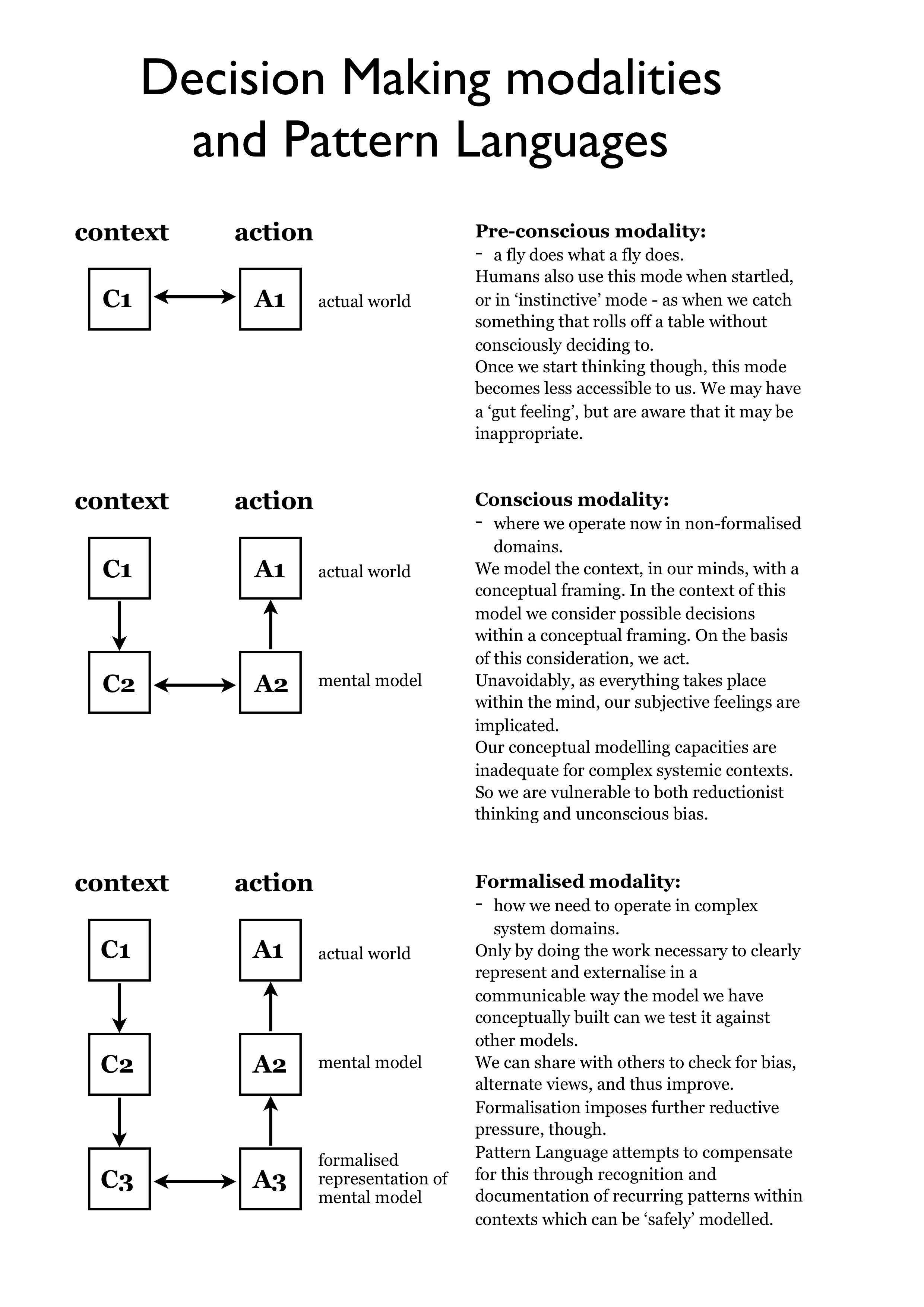
What are Pattern Languages for ?
"In order to become more adept at managing human-made environments we need to get the decision making process out of our minds - use some kind of formalised representation."
"Pattern Language approaches seek to develop a formalisation mode that simultaneously meets several requirements.
We wish to be able to analyse and document complex human-made systems in a way that supports us well. The format needs to be at once loose - to avoid mechanistic reductivism - and rigorous - to tease out cognitive bias and maximise clarity. It needs to be applicable to a wide variety of cases and conditions - human-made systems operate on multiple interacting levels, from the brute mechanical to the pre-consciously emotional. It needs to be useful - easy to interact with and understand, adaptable to the specifics of circumstance, yet definitive.
Build Pattern Languages to document the recurring conditions of complex human-made environments, to develop understanding, to communicate analysis, and to support safer and wider intervention and design.
Make sure that the languages you build are engaging and open to development - that they constitute a developing and dynamic Living Language . Do what you can to encourage an understanding of the language as Social Poetry, and not any kind of meccano-like constructor set. Engage with relevant stakeholders within the domain, seek their involvment and encourage the development within that community of groups of Language Gardeners."
- Dil Green [1]
See the Graphical representation by Christopher Alexander at [2].
Frameworks as Meta-Patterns
The P2P Foundation has been inspired by several frameworks of interpretation, which could be seen as the organizing systems holding patterns together:
- The Relational Model Typology - Fiske, which you can find described i Alan Page Fiske's book, Structures of Social Life
- The Modes of Exchange framework, which you can find in Kojin Karatani's book, The Structure of World History
- The TIMN, i.e. Tribes, Institutions, Markets, Networks framework, from David Ronfeldt; recently adapted by the TIME Framework by Michael Haupt.
-The AQAL framework by Ken Wilber, which you can find in our section on Integral Theory.
Key Resources
Pages in category "Patterns"
The following 89 pages are in this category, out of 89 total.
B
C
E
F
G
H
L
M
P
- Pattern Dynamics
- Pattern Language
- Pattern Language for Alternative and Complementary Money Systems
- Pattern Language for Crypto Design
- Pattern Language for Self-Organizing Systems
- Pattern Languages
- Pattern Languages for Social Change
- Pattern of the Pulse
- Pattern Recognition Algorithms for Civilizational History
- Patterns in Network Architecture
- Patterns of Commoning
- Patterns Of Demonetization
- Patterns of Peeragogy
- Patterns That Connect
- Paul Graham's Hierarchy of Disagreement
- Peak Everything
- Pitirim Sorokin on Cultural Recurrences
- Power Law of Participation
- Principle of Competitive Exclusion
- Principle of Limits
- Production Network Effects
- Proto-Social Protocols
- Protocols for Autodidactic Physical Systems
- Protocols for Postcapitalist Expression
- Pulsation of the Commons
- Punctuated Equilibrium vs Gradual Evolution